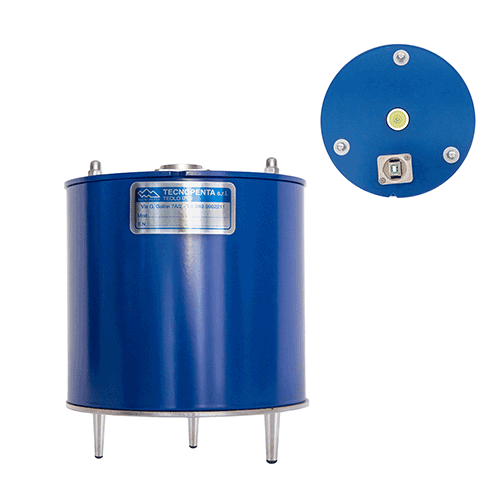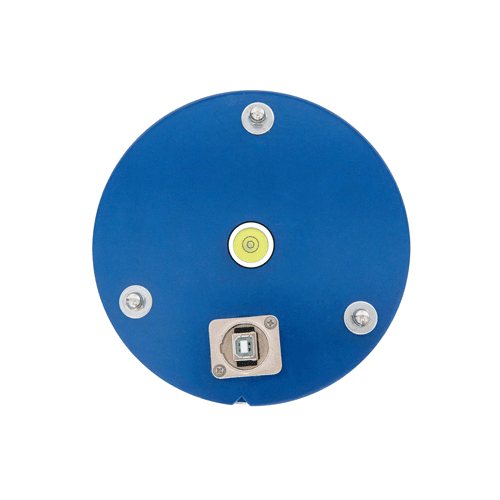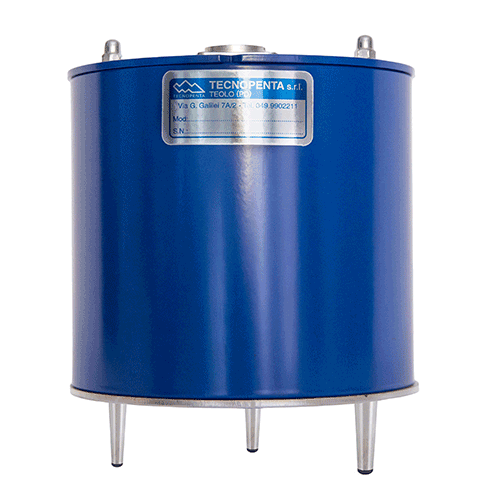

This device is a complete solution for HVSR (Horizontal-to-Vertical Spectral Ratio) acquisitions, specifically designed for passive geophysical surveys, subsurface explorations, structural health monitoring, and seismic monitoring. Thanks to its advanced technical features, this tri-axial geophone, when paired with a comprehensive data acquisition software, enables a wide range of precise measurements—essential for in-depth analysis of soil behavior and structural response.
A geophone is a sensor designed to detect ground vibrations by converting the elastic waves propagating through the soil into usable electrical signals. In essence, it functions as a velocimeter: as the speed of vibration changes, the geophone generates a proportional electrical signal. This principle makes it possible to monitor natural phenomena such as earthquakes or landslides, as well as man-made vibrations caused by traffic, construction, or heavy machinery.
The operating principle is based on an electromagnetic transducer made up of a coil and a magnet. When the ground vibrates, the internal mass of the geophone moves relative to the coil, inducing an electrical current that corresponds to the velocity of the vibration.
Sensor: Electromagnetic transducer (coil and magnet), ensuring high sensitivity and measurement accuracy
Natural Frequency: Between 4.5 Hz and 14 Hz – ideal range for detecting typical ground and structural vibrations in HVSR testing
Sensitivity: Measured in volts per millimeter per second (V/mm/s), a crucial parameter for converting vibration into accurate electrical signals
Impedance: In the range of several hundred ohms, optimized for easy integration with data acquisition systems
Environmental Protection: IP67 rating, offering resistance to dust and temporary water immersion—ideal for harsh field environments
Software: Allows for timed data acquisition, with customizable frequency and duration settings. During testing, data can be viewed graphically in real time
This instrument is engineered for professionals in the fields of geophysics and seismic monitoring who require precise, reliable measurements in a wide variety of conditions. With its optimized frequency response, high sensitivity, and robust environmental protection, it is suitable for use in both open-field geophysical investigations and structural monitoring of buildings and infrastructure.
Collected data is fully compatible with most commercial and open-source processing software, ensuring flexibility and ease of analysis.