Select your language




Case studies
What is a Digital Rain Gauge?
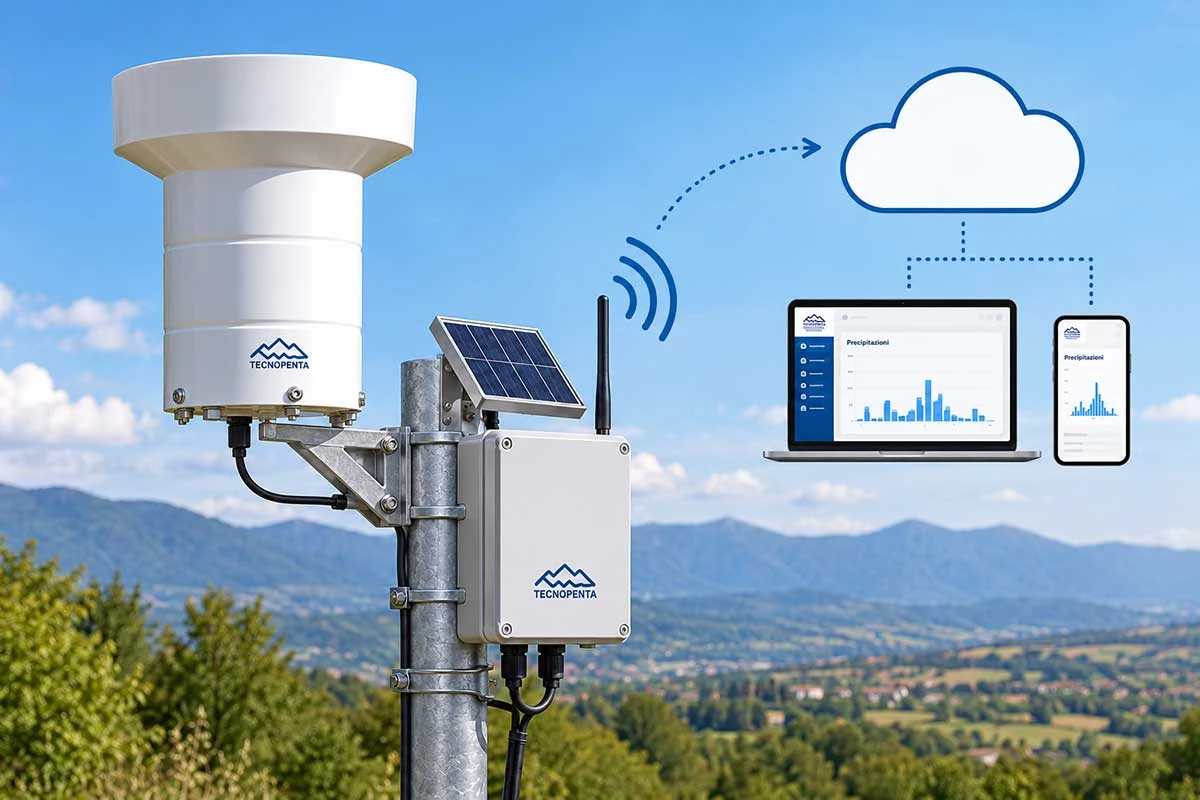
A digital rain gauge is an instrument used to measure the amount of rainfall recorded over a given period of time.
Unlike a manual rain gauge, which requires an operator to directly read the collected water, a digital model generates an electrical pulse according to the rainfall and can transmit the data to a data logger, SCADA software or a web platform for remote monitoring.
This type of instrument is used in weather stations, environmental monitoring and hydrogeological monitoring, agriculture and warning systems. Automatic recording makes it possible to determine not only cumulative rainfall, but also its distribution over time and, with an appropriate acquisition frequency, the intensity of rainfall events.
How does a digital rain gauge work?
One of the most widely used systems is the tipping bucket rain gauge. Rainfall is collected by a funnel with a known surface area and directed towards a mechanism consisting of two small buckets.
When one bucket reaches the preset volume, it tips and empties while the other moves into the collection position. Each tipping action generates an electrical pulse, usually through a reed-type magnetic contact.
The data acquisition system then converts the number of pulses into the corresponding amount of rainfall. For example, if each pulse corresponds to 0.2 mm of rainfall, five tipping events represent a cumulative rainfall of 1 mm.
What data can it provide?
The value directly measured by the rain gauge is the amount of precipitation. From the time sequence of the pulses, the acquisition system can determine several parameters:
- cumulative rainfall;
- daily, monthly or annual rainfall;
- duration of the rainfall event;
- rainfall intensity;
- start and end time of the event;
- exceedance of preset thresholds.
Rainfall intensity is not normally measured directly by a tipping bucket rain gauge, but is calculated from the amount of rainfall recorded over a given time interval. For this reason, it is important to correctly configure the data acquisition frequency.
Digital rain gauge and manual rain gauge
A manual rain gauge collects water in a graduated container and requires an operator to take the reading.
A digital rain gauge, when connected to a data logger, automatically records rainfall events and allows measurements to be integrated into data acquisition and monitoring systems.
Automatic measurement enables continuous precipitation monitoring, time-stamped event recording, rainfall intensity calculation, remote access to data and the management of thresholds and alarms.
Where is it used?
The digital rain gauge is used in many different sectors. In weather stations, it can be installed together with temperature, humidity, atmospheric pressure and wind speed sensors.
In hydrogeological monitoring, rainfall data can be correlated with rising watercourses, groundwater level variations or movements of landslides and slopes, making the rain gauge an important component of monitoring and warning systems.
In agriculture, it is used to evaluate natural water supply and support irrigation planning, while at construction sites, quarries, landfills and environmental facilities it can document rainfall events and compare them with other monitored parameters.
Connection to data loggers and remote monitoring systems
A tipping bucket rain gauge generally provides a pulse output: each pulse represents a defined amount of rainfall and is acquired by a digital input or dedicated counter.
The data logger stores the pulses, applies the conversion coefficient and generates the measurement in millimetres. Measurements can be stored locally or transmitted via mobile network, radio, LoRaWAN or other communication technologies.
A monitoring platform makes it possible to view data through graphs and tables, compare multiple stations, export measurements and receive notifications when specific rainfall thresholds are exceeded.
Installation and maintenance
To obtain reliable measurements, the rain gauge must be installed on a stable and correctly levelled support, in a position as free as possible from trees, buildings and other obstacles that could intercept rainfall or alter the effect of the wind.
It is also important to carry out periodic checks, verifying the cleanliness of the collector, the correct movement of the tipping buckets, the drains and electrical connections.
Leaves, insects, dust and other materials can obstruct the funnel or drain opening, causing delays or errors in rainfall recording.
How to choose a digital rain gauge
The selection should take into account the collection area, resolution, declared accuracy, measurable intensity range and compatibility with the data acquisition system.
It is also necessary to consider the environmental conditions of the site, operation during snow or freezing conditions, the type of electrical output, the distance from the data logger and the requirements for data transmission and alarm management.
For professional applications, the rain gauge should not be considered as an isolated component: data quality depends on the entire measurement chain, including sensor, installation, acquisition, transmission, configuration and maintenance.
Tecnopenta systems for precipitation monitoring
Tecnopenta develops precipitation monitoring systems configured according to the characteristics of the site and the objectives of the project.
The digital rain gauge can be integrated with data loggers, autonomous power supply systems, remote transmission devices and platforms for remote data access.
The instrumentation can also be combined with water level sensors, piezometers, inclinometers and other instruments to create monitoring networks for meteorological, environmental and hydrogeological applications.