Select your language




Case studies
Monitoring of Temporary Supports
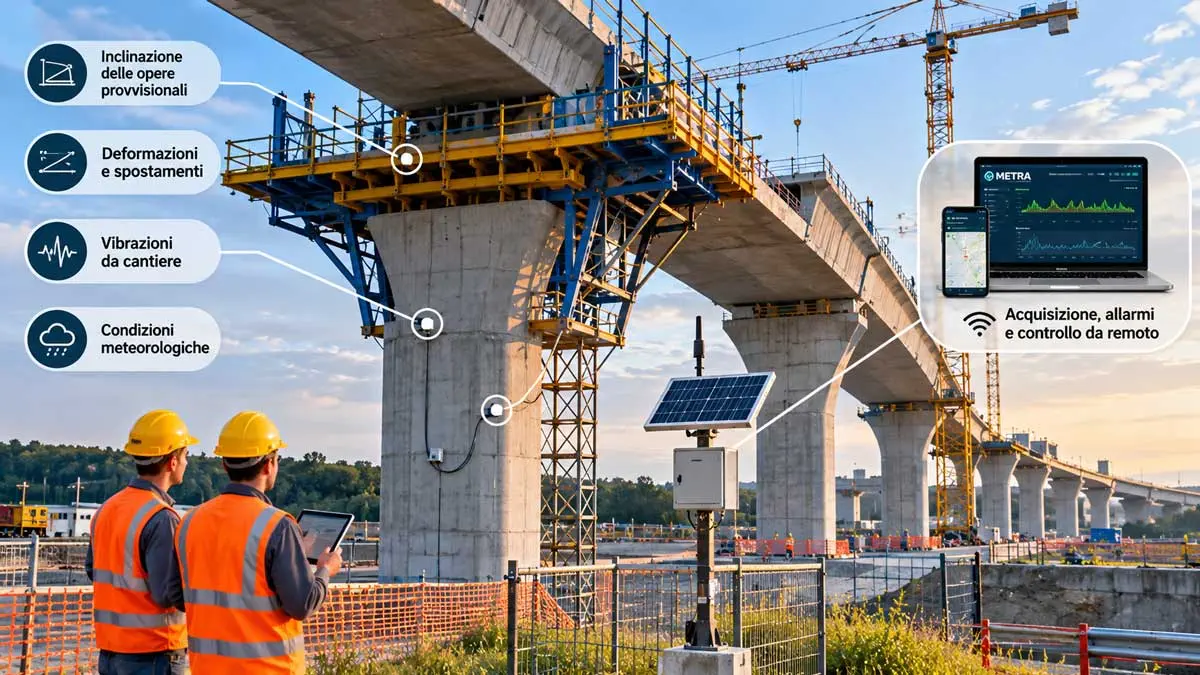
During the construction of a bridge, the behaviour of temporary supports can be monitored using an automatic monitoring system for rotations and vertical settlements.
The measurements follow the different load stages and provide technicians with a continuous record of the evolution of the monitored points.
The configuration includes biaxial inclinometers, an automatic levelling system and an acquisition unit. Integrating the two types of measurement makes it possible to observe angular variations and vertical movements of the supports separately.
Monitoring rotations and settlements
The biaxial inclinometers are fixed to the elements to be monitored and detect changes in inclination along two orthogonal directions.
The sensor positioning is defined according to the geometry of the supports and the movements to be observed during the different construction stages.
The levelling system, on the other hand, measures vertical displacements relative to a stable reference point located outside the area affected by movement.
An initial reference reading makes it possible to express the variations relative to the starting condition of the monitoring activity and to follow the evolution of temporary support settlements over time.
Automatic data acquisition
A control unit from the FlexLog family automatically collects measurements according to the intervals defined for the construction site.
The configuration of the inputs and interfaces is selected according to the signals from the inclinometers, the levelling system and any other instruments integrated into the station.
Automatic monitoring makes continuous time series available and allows the trends of the different measurement points to be compared during the progress of construction activities.
Data transmission and METRA platform
The acquired data can be transmitted to the METRA platform for remote consultation of the measurements.
The time series make it possible to compare the rotations and vertical settlements of the different monitored points and to relate the recorded variations to the construction activities and subsequent structural load stages.
Centralizing the information also makes it possible to keep the data acquired during the different construction phases available and to use them as support for technical checks.
Management of thresholds and inspections
The system can be configured to generate alerts when preset thresholds are exceeded.
The thresholds and subsequent procedures are defined by the monitoring managers according to the expected behaviour of the structure and the specific requirements of the construction site.
This architecture makes it possible to organize the monitoring of temporary supports through repeated measurements, automatic acquisition and archived data, keeping the information required for technical checks available throughout the progress of bridge construction.